





Finance the construsction of a battery storage projects in Poland.
The project Polonia Pulawi Storage aims to finance the construction of a battery energy storage system (BESS) in Poland. This stand-alone BESS project is led by RelyAssets, a Spanish company specialized in the development, construction, and operation of battery storage and hybrid renewable energy projects worldwide, with an established presence in Poland, Italy, Chile, and Mexico.
The fundraising campaign seeks to raise a first tranche of 1.1M€ with a ceiling that can be increased to €2.3 million , with a total fundraising target of €2.3 million. The funds will cover up to 85% of the capital expenditures (CAPEX) required for the construction of the BESS of 4MW in Poland.
The offer
A bond issue to finance a BESS project in Poland
Objective
The operation aims to raise a first tranche of 1.1 million € with a ceiling that can be increased to €2,300,000 with a total fundraising target of €2.3 million, in the form of senior debt.
Use of Funds
The funds will be used by RelyAssets to finance up to 85% of the CAPEX required to build the BESS.
Repayment
The repayment strategy is based on two options:
-
Preferred option: bank refinancing
After at least one year of operation, the project will be able to secure predictable revenue through the establishment of toll agreements/offtake agreements. This guaranteed revenue will enable the project to secure bank refinancing on optimal terms.
-
Alternative option: refinancing campaign
As a complement to or alternative to bank refinancing, a refinancing campaign may be considered.
This funding can therefore be regarded as bridge financing: it enables the project to be launched and its operational viability demonstrated before it is refinanced on the basis of contracted and secured revenues.
Security
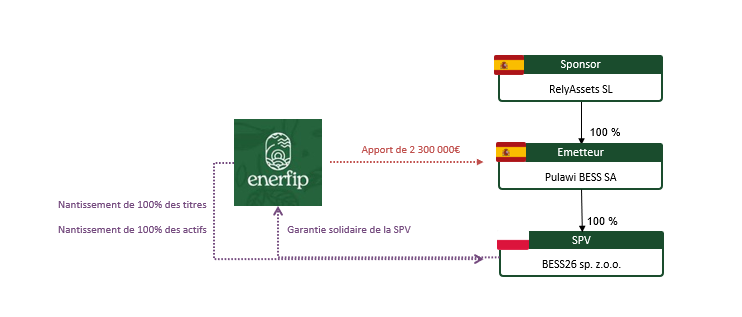
The guarantees consist of a pledge over 100% of the shares of the Polish special purpose vehicle (SPV BESS26 sp.z.o.o).
1) A first-ranking pledge of 100% of the share capital of the SPV (BESS26 sp. z.o.o.).
2) A first-ranking pledge of 100% of the SPV’s assets.
3) Joint and several guarantee by the SPV: The SPV guarantees all payment obligations of the issuer to the Bondholders on an unconditional and irrevocable basis in case of default.
Financial Structure
· Issuance of simple bonds in Spain by Puławy BESS S.A.
· Maturity of 2 years with an annual interest rate of 9,50%
· Pledge over 100% of the SPV shares and assets in Poland
Specifications
Investment phases
- Investment open to everyone
End of project financing
Resources
Simulator
Investment simulation
Polonia Pulawi Storage -
Obligation
9.5%/year over 2 years
Simulation - Rate : 9.5% / year on 2 ans
Initial investment:
€5,000
Repayments and interest:
€5,950
In 2 transfers
| Date | Interest* | Capital | Amount |
| 20/05/2027 | €475 | €0 | €475 |
| 20/05/2028 | €475 | €5,000 | €5,475 |
| Total | €950 | €5,000 | €5,950 |
|
*Gross interest before tax, including all fees ( view taxation ) The dates are indicative. The final dates will be available once the project is officially closed. The result presented is not a forecast of the future performance of your investments. It is only intended to illustrate the mechanics of your investment over the investment period. The evolution of the value of your investment may vary from what is shown, either increasing or decreasing. |
|||
Interested in this project?
Sign up now to invest responsibly
The project
Location of the project:
The project developed by RelyAssets involves the construction of a stand-alone battery energy storage system (BESS) in Poland, in the city of Lubelskie Voivodeship. This location is strategically chosen to maximize its impact on the grid and the market.
💡 BESS ? A Battery Energy Storage System (BESS) uses large-scale batteries to store electricity and release it when needed, helping balance supply and demand, especially as more renewable energy is integrated into the grid. By absorbing excess energy and supplying it during peak periods, BESS enhances grid stability and flexibility. It also provides services such as frequency regulation and reserve support.
By investing in this standalone BESS project in Poland, you are directly supporting the transition toward a cleaner and more resilient energy system. As solar and wind capacity continue to grow rapidly, their intermittent nature creates increasing challenges for grid stability—this is where BESS becomes essential. Energy storage allows excess renewable electricity to be captured when production is high and released when demand peaks, ensuring reliability without relying on fossil fuels. In Poland, where the energy mix is still carbon-intensive, enabling higher penetration of renewables has a tangible impact on decarbonisation.
Details of the Project Progress
The battery project is currently Ready to Build (RTB) with an installed capacity of 4MW . It covers 588 m² and is adjacent to the grid connection point. Using existing or clearly defined connection infrastructure helps to streamline development, control costs, and reduce execution risks. For the electricity sale strategy, BESS will have two main roles; absorb excess energy and supply it during periods of peak demand and provides services such as frequency regulation and reserve support.
|
Surface project
(m²) |
Land Contract | Land Status |
Distance to connection point
(km) |
Connection Type |
Grid Connection Voltage
(kV) |
Connection Status |
|---|---|---|---|---|---|---|
| 588 m² | Land Lease Agreement | Secured | 0, Project is adjacent to the substation, ie no line of interconnection | Dedicated substation | 15 |
Grid Connection Agreement signed with DSO: 11/07/2025
Grid Connection works awarded to EPC: 15/01/2026 |
Technical Specifications and Performance
The project uses lithium-iron phosphate (LFP) battery technology , providing a total installed capacity of 16.72 MWh and designed for 4 hours of storage. LFP batteries are known for high thermal stability, shock resistance, and long lifespan. With an expected 20-year operational life and 85% round-trip efficiency , the system meets current market benchmarks for large-scale energy storage. LFP technology also supports reduced costs for EV batteries and extended longevity.
| Technology | Battery Type |
Power
(MW) |
Capacity
(MWh) |
Discharge duration
(h) |
Life Cycle
(years) |
Round-Trip rate
(%) |
Time of answer
(ms) |
|---|---|---|---|---|---|---|---|
| BESS stand alone | LFP | 4 | 16,72 | 4 | 20 | 85% | 20ms |
Key stakeholder for project construction
- HVS HVS will be responsible for the engineering and construction of the project. Founded in 2013 in Poland, HVS (High Voltage Systems) is a company specializing in energy and industrial solutions. Initially focused on relay protection and remote monitoring systems, HVS has since expanded its expertise to include electrical substation modernization, covering low, medium, and high-voltage distribution systems. The company also provides maintenance services for installed equipment and carries out electrical works in industrial facilities and production lines.
HVS handles turnkey projects, managing all aspects from design and regulatory approvals to equipment supply, installation, configuration, and commissioning. Operator training and after-sales services are also part of the offering. With a team of skilled engineers, HVS delivers reliable solutions for large-scale energy and electrical infrastructure projects, establishing itself as a solid partner in the sector.
- RelyEZ RelyEZ Energy Storage Technology is a Tier 1 battery energy storage system (BESS) manufacturer as classified by BloombergNEF. The company’s products are covered by performance guarantees backed by Munich RE insurance. This industrial positioning supports the technical validation and bankability of projects across its geographic markets.
What about the Polish Energy Market?
Poland has a supportive legal framework for renewable energy , including the 1997 Energy Law, the 2015 Renewable Energy Act, and the 2017 Capacity Market Act, which together regulate the electricity market, encourage investment, and allow battery storage systems to earn revenue while improving energy security.
At the same time, its Energy Policy to 2040 (PEP2040) aims to **shift toward a low-emission system **by supporting coal region transition, expanding offshore wind and nuclear energy, and improving air quality, with strong economic and social benefits.
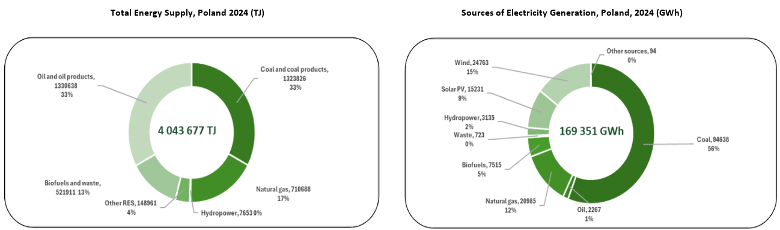
Electricity in Poland in 2024 was mainly generated from coal (56%), followed by wind (15%) and natural gas (12%). The country’s overall energy supply was largely dominated by fossil fuels, with coal and coal products accounting for 33%, oil and oil products for 33%, and natural gas for 17%.
Market Opportunity
Battery storage assets in Poland generate revenue from multiple complementary market mechanisms. Batteries are competitive due to their fast response times, enabling participation in ancillary services. Energy arbitrage opportunities are increasing as renewable penetration drives greater price volatility on the wholesale market.
Entering the Polish market at this early stage offers strategic advantages. The regulatory framework is developing, and competition in the storage segment remains limited compared to mature European markets. Early entrants can secure favorable capacity contracts , establish positions in ancillary services, and capture higher arbitrage spreads before market normalization occurs as storage deployment becomes more widespread.
Focus on BESS
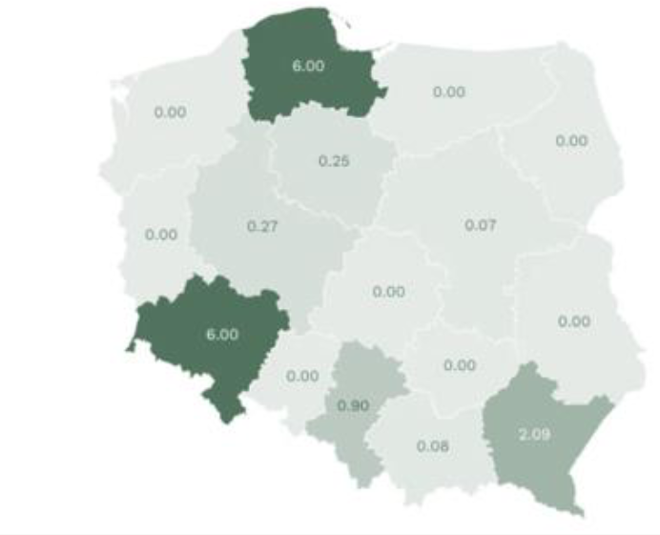
Battery Energy Storage Systems (BESS) in Poland are still at an early stage, with only 274 MW installed by the end of 2024 despite a relatively high number of units, indicating mostly small-scale systems. However, the outlook is strong, with 4.3 GW of projects planned for 2027–2029, showing rapid future growth . As renewables already account for 30% of energy production, BESS will play a key role in supporting further expansion and grid stability.
| Metrics | Value |
|---|---|
| Storage Capacity at the end of 2024 | 274 MW |
| Contracted projects from 2027 to 2029 | 4,3 GW |
| Share of renewable energy in total energy production | 30% |
Interested in this project?
Sign up now to invest responsibly
Project owners
| Global Rely Assets Key figures | |
|---|---|
| Experience in Development and Financial Structuration | +15 years |
| Numbers of Collaborators | 16 |
| Projects under development BESS (GW) | 2,5GW representing more than +10GWh of stored energy |
| Projects RTB (MW) | 150MW+ |
Meet the Team
 Emeric Gouraud
Co-founder & CEO, RelyAssets
Emeric Gouraud
Co-founder & CEO, RelyAssets
|
Emeric brings 8 years of experience as a bankers at Natixis Investment Bank, including acquisition deals for infrastructure and energy projects across Europe, Latin America, and the United States. He then spent 4 years as Head of Financing and Investments at a European independent power producer, where he oversaw the financing of more than 500 MW of photovoltaic projects and raised over €500 million in equity. |
 Olivier Potart
– CEO, RelyAssets and former founder of Antuko
Olivier Potart
– CEO, RelyAssets and former founder of Antuko
|
Olivier has 15 years of experience in the energy sector as founder and CEO of Antuko, where he developed a broad range of activities including energy trading, price forecasting, asset management, advisory, and project development. Prior to that, he spent 10 years in banking, from investment banking to equity derivatives structuring at Societe Generale in Spain. He also spent 7 years as an entrepreneur in the hospitality industry in Chilean Patagonia. |
Our analysis
Risk overview
Construction risks
Risk of construction delays or failure to complete the work
Mitigation methods
RelyEZ is a reliable supplier with a proven track record of delivering in accordance with the specifications. The amount of connection work required is minimal due to the proximity of the connection point. HVS is a company with a proven track record in carrying out electrical work. Additionally, RelyAssets has a contract with ATA (engineering and advisory services for renewable energy,) for quality control over the projects.
Counterparty risk
Risk of counterparty payment default that would jeopardize the project's cash inflows
Mitigation methods
The project initially operates under a fully merchant model with short-term market exposure, limiting long-term counterparty concentration risk. Revenues are primarily generated through organized power exchanges and balancing markets, where settlement is typically guaranteed by clearing houses and regulated entities, significantly reducing default risk. Optimization is entrusted to an experienced and established (German) market player, ensuring robust commercial execution and access to high-quality counterparties. After the first year of operation, the project intends to implement a tolling or floor revenue structure, securing a minimum level of contracted income and further reducing exposure to merchant risk. Revenue diversification across multiple market segments and early market entry further support the resilience of cash flows.
Country risk
Risk of devaluation of local currency, which could impact revenues and compromise ability to service debt.
Mitigation methods
The currency risk associated with the volatility of the zloty remains a risk factor for the sponsor. Poland’s economy is tightly integrated with the Eurozone, creating a strong structural alignment between PLN and EUR and limiting the risk of divergence. Also a significant portion of electricity prices in Poland is structurally correlated with European power markets, which are themselves influenced by euro-denominated drivers (e.g., fuel prices, carbon prices), providing a natural hedge over the long term. Volatility EUR-PLN was between 3%-4% in 2024 and 2025.
Country risk
Risk of policy change
Mitigation methods
Poland is a member of the OECD and EU, and is experiencing strong growth in Europe The regulatory framework is favourable to renewable energy projects, and the energy policy is mainly shaped in Brussels.
Development risk
Risk relating to authorizations issued to the company and land, and third-party appeals against authorizations issued.
Mitigation methods
The project has already reached the RtB stage. The land contracts have been signed and notarised. The connection has been secured, and work can begin as soon as the funds are received via an LTNP. The planning permission has been granted and is free from any appeals.
Refinancing risk
Credit risk related to the company's ability to refinance and meet its debt obligations.
Mitigation methods
The financing terms for a revenue-generating project are clearly more favourable. The context of rising MWh prices highlights the need to install this type of asset. There are various strategies for securing revenue, ranging from conservative to aggressive. The guarantees include coverage throughout the entire financial transaction. The sale of projects following their construction is not ruled out. The project is expected to transition from a fully merchant profile to a partially contracted structure, with the sponsor already having received indicative offers for long-term tolling and floor price agreements. These contracted revenues will provide strong cash flow visibility, enabling access to long-term project financing under standard infrastructure terms. This phased approach significantly reduces refinancing risk and supports attractive debt conditions post-COD (commercial operation date).
Operating risks
Risk related to an activity that depends on a limited number of key persons responsible for carrying out the planned strategy. The risk is that one of these key persons leaves the project.
Mitigation methods
The developer's financial capacity aligns with industry standards for companies of this size. The management team includes co-CEOs with expertise in finance and electricity markets. The main shareholder, a leading battery manufacturer, provides strategic and financial support to the project.
Operating risks
Risk of poor project operation, faulty workmanship or machine breakdown resulting in poor performance.
Mitigation methods
The limited scale of the project (4 containers) reduces operational complexity. The optimization platform is operated by a provider with demonstrated experience managing larger-scale battery projects in Germany.
Operating risks
Risk of delays in the supply chain
Mitigation methods
Preventive and corrective maintenance contracts with equipment suppliers.
Operating risks
Technological risk that the system will not perform as expected, or that performance will degrade more rapidly than anticipated.
Mitigation methods
The technology provider is owned by one of the project's main shareholders, creating alignment of interests in project success. The Battery Supply Agreement includes a 15-year performance guarantee backed by Munich RE reinsurance (S&P rating: AA).
Investing in this participatory financing project involves risks, including the risk of total or partial loss of the capital invested. Your investment is not covered by the deposit guarantee schemes established in accordance with directive 2014/49/EU of the European Parliament and of the Council . Your investment is also not covered by the investor compensation schemes established in accordance with Directive 97/9/EC of the European Parliament and of the Council . Return on investment is not guaranteed. This is not a savings product, and we recommend that you not to invest more than 10% of your net assets in participatory finance projects. You may not be able to sell the investment instruments when you wish. If you are able to sell them, however, you may incur losses.