





Finance the acquisition of a RTB ground-mounted solar project in Italy
Following the success of two fundraisings on Total Energies Invest for BESS projects in Italy and Canada in 2025 and 2026, Alternative Green Energy is now launching a third fundraising campaign for a solar photovoltaic project.
The project Ariano Solar aims to finance the acquisition and the final permits of a ground-mounted solar photovoltaic project in Italy , with a capacity of 28.8 MWp. The project is led by Alternative Green Energy (AGE), a Spanish company specializing in the development, engineering, and construction of renewable energy projects across Europe and beyond.
The fundraising campaign seeks to raise €2,300,000. The funds will cover the acquisition, the initial construction works, and the final permits required to reach the Ready-to-Build (RtB) stage.
The offer
Objective
The operation aims to raise a single tranche of €2,300,000 in the form of simple bonds.
Use of Funds
The funds will be used by AGE to cover the first acquisition milestone of the project (100%), along with initial construction works and the final permits required to reach the Ready-to-Build (RtB) stage.
Repayment
The refinancing strategy prioritizes the sale of the project after it goes live, or the entry of a partner into the project. The contract includes the option to refinance through a new round of fundraising.
Security
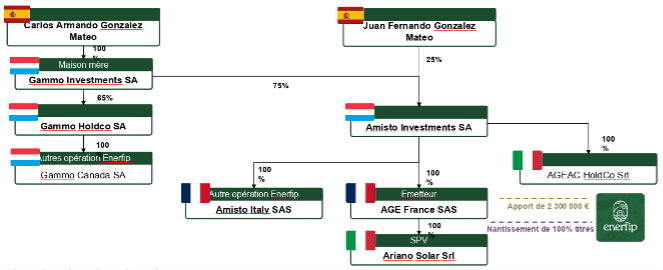
– Pledge of 100% of the shares in the Italian SPV
– Temporary guarantee from Gammo Investments SA’s parent company, GAPD
– Requirement to submit a PPA and Energy Release agreement within 6 months, extendable by 3 months at Total Energies Invest’s discretion. In the event of failure to submit these documents, Total Energies Invest reserves the right to require Alternative Green Energy to sell the project.
Pledge details
To allow the project to access construction financing, bondholders have pre-authorised the Mass Representative to coordinate the ranking of this pledge with other lenders if needed, and to sign any related agreements on their behalf. Mainly, the first rank pledge might be changed to a second rank pledge to allow for the senior financing and the construction of the plant which is necessary to sell the project at COD.
With a second rank pledge, in the event of a default, bondholders’ security would allow investors to recover funds once bank debt obligations have been fully repaid, with any remaining balance reverting to bondholders thereafter.
Financial Structure
-
Issuance of simple bonds in France by AGE France SAS
-
Maturity of 2 years with an annual interest rate of 9%
Specifications
Investment phases
- Investment open to everyone
End of project financing
The closing date for contributions may be extended at the request of the project owner.
The return on your investment will be calculated from the date the subscription certificates are generated, i.e. once all the funds have been received and the legal documentation has been signed by the project owner.
Resources
Simulator
Investment simulation
Ariano Solar -
Obligation
9%/year over 2 years
Simulation - Rate : 9% / year on 2 ans
Initial investment:
€1,000
Repayments and interest:
€1,180
In 2 transfers
| Date | Interest* | Capital | Amount |
| 29/06/2027 | €90 | €0 | €90 |
| 29/06/2028 | €90 | €1,000 | €1,090 |
| Total | €180 | €1,000 | €1,180 |
|
*Gross interest before tax, including all fees ( view taxation ) The result presented is not a forecast of the future performance of your investments. It is only intended to illustrate the mechanics of your investment over the investment period. The evolution of the value of your investment may vary from what is shown, either increasing or decreasing. |
|||
Interested in this project?
Sign up now to invest responsibly
The project
Localisation of the project
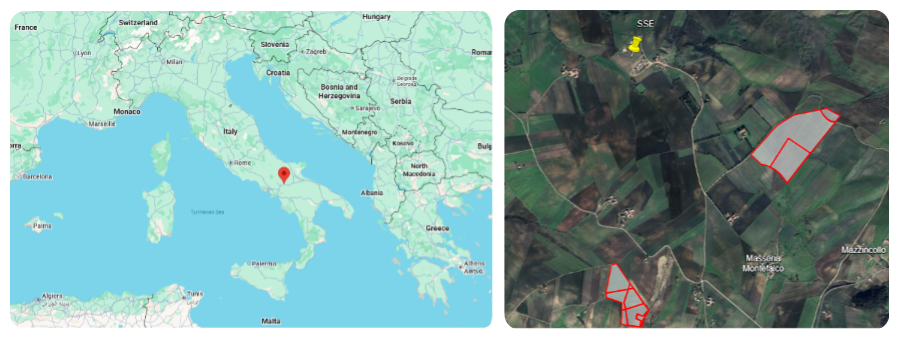
Ariano Solar is a ground-mounted solar photovoltaic project located in Ariano Irpino, in the Campania region of southern Italy.
The project is developed across 3 sites totaling 34.57 hectares: two sites dedicated to the solar plant, for which the SPV holds surface rights, and one site for the electrical substation (SSE), owned by the SPV.
Capacity and yield
With an installed capacity of 28.80 MWp and an estimated energy yield of 1,684 kWh/kWp/year (P90), the project benefits from the strong solar irradiation characteristic of this region, making it a well-positioned asset in the Italian renewable energy landscape.
💡P50 ou P90 ?
The P50 and P90 yields refer to the probability of achieving the expected output in any given year. Since solar photovoltaic production is directly tied to weather conditions, it is subject to daily and annual variability.
The P50 yield represents a 50% probability of meeting the expected output. It is therefore an optimistic estimate, as it is only achieved, on average, one year out of two.
By the same logic, the P90 yield carries a 90% probability of being achieved, making it a more conservative benchmark. For this reason, most business plans are required to be built on P90 production estimates, ensuring a prudent financial foundation even in less favorable conditions.
Development status
As of January 2026, the project has reached a quasi Ready-to-Build (RtB) status, with the remaining milestone being the completion of the shared substation and the completion of minor permitting validations.
Details and Technical Specifications of the Project
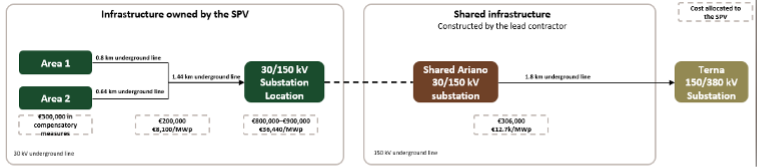
Ariano Solar is part of a shared infrastructure scheme with five co-developers, connected to the SET Terna 150/380 kV national grid via the Ariano 30/150 kV substation.
The total construction cost of the shared infrastructure amounts to €3 million, broken down as follows: €1 million for the shared Ariano SET substation and €2 million for the grid connection line to the Terna SET. This cost is distributed proportionally among all five developers, all of whom have already signed the cost-sharing agreement.
Ariano Solar is highly likely to serve as lead developer (Capo Fila), reinforcing its strategic positioning within the project cluster and its proximity to the grid connection point.
| Parameter | Value |
|---|---|
| Grid Connection | SET Terna 150/380 kV |
| Shared Substation | Ariano 30/150 kV |
| Underground Line | 1.8 km |
| Total Shared Infra. Cost | €3 million |
| Number of Co-developers | 5 |
| Combined Capacity | 235 MW |
Key Stakeholders for Constructions
The Ariano Solar project involves a group of partners, covering development, financing, construction, and equipment supply.
AGE currently holds 25% of the project and is in the process of acquiring the remaining 75% from OMNES Capital, which will result in full ownership of the asset upon completion of this transaction. This fundraising campaign partly supports this acquisition milestone.
OMNES Capital — Current Co-owner (75%)
OMNES Capital is a major French private equity firm specializing in infrastructure, energy transition, and development capital. Founded in 1999 as a subsidiary of Crédit Agricole, OMNES is now an independent company managing several billion euros in assets. With 4.4 billion EUR in renewable energy assets under management, a portfolio of 980 projects.
Further reading
💡Article by Total Energies Invest: The outlook for the solar market in Europe
💡Article by Total Energies Invest: Why invest in solar power?
💡 Article by Total Energies Invest: Investing in renewable energy through responsible investment in Italy
💡 Article by Total Energies Invest : Different project phases
Interested in this project?
Sign up now to invest responsibly
Project owners
Alternative Green Energy (AGE) is a Spanish company specializing in the development of large-scale renewable energy projects.
Founded in 2015 and based in Barcelona, AGE is a recognized player in the sector, with over 15 years of experience.
AGE primarily develops and builds ground-mounted solar photovoltaic plants, but is also active in other strategic areas such as battery energy storage systems (BESS), onshore wind, and the production and distribution of green hydrogen. Its approach is based on an integrated vision of the energy transition, combining production, flexibility (through storage) and infrastructure.
The company has a portfolio of 23 GW of projects under development in 12 countries, and has already commissioned more than 3 GW of installed capacity. It also holds exclusive rights to a global portfolio of over 10 GW of solar projects at an advanced stage of development.
| Technical indicators |
Development Capacity
(MW) |
RTB/Construction Capacity
(MW) |
Operational Capacity
(MW) |
Total
(MW) |
|---|---|---|---|---|
| Solar | 9 545 | 28 | - | 9 573 |
| Wind | 910 | - | - | 910 |
| BESS | 13 014 | - | - | 13 014 |
| Total | 23 469 | 28 | - | 23 497 |
AGE is involved across the entire project value chain, from site identification through commissioning and operation. The company handles technical aspects in-house (engineering, system sizing, technology selection), as well as regulatory matters (permitting, grid connection), financial aspects (financial modeling, fundraising), and operational activities (construction and operation).
With operations in multiple regions worldwide, including Southern Europe (Spain, Italy, Greece), Latin America, North Africa, and Asia, AGE operates within local regulatory and market frameworks while relying on standardized industrial processes.
To adapt to the growth of the group, AGE engaged a group-wide reorganization to structure its international activities around country-specific branches. The reorganization started in 2025 and is still ongoing, as a result of this financing, all Canadian activities will be transferred under Gammo Canada S.A., a newly created entity. The consolidated annual financial statements reflecting the new organization will be available later this year, and for the purpose of this financing, the financial analysis of the Sponsor’s creditworthiness was performed on AGEAC Holdco Srl, which until 2025, consolidated most of the Group’s projects and value.
Track Record on Total Energies Invest
Alternative Green Energy has already successfully raised funds through the Total Energies Invest platform on two previous campaigns.
AGE Storage Italy: This fundraising campaign aimed to finance the development of 7 BESS projects in Italy, structured as simple bonds over 2.5 years at a rate of 9.50% per year. All land has been secured and the STMG deposit has been paid, with the first repayment scheduled for November 2026.
Aurora Storage: This campaign financed the development costs of 6 battery energy storage projects of 100 MW each, located in Alberta, Canada, led by Gammo Investments S.A. Structured as simple bonds over 3 years at 9.50% per year. The campaign is now closed since March 2026, with the first repayment due in March 2027.
Our analysis
Risk overview
Commercialization risk
Risk related to the commercialization of a new offering
Mitigation methods
AGE has significant experience in developing renewable energy projects. The company has demonstrated its ability to structure, finance, and complete complex projects, drawing on specialized teams in engineering, project management, and regulatory compliance. Furthermore, AGE benefits from strong partnerships with recognized industrial and financial players, enabling it to secure its projects throughout their entire lifecycle. Its track record in similar competitive environments reinforces its legitimacy and resilience in executing the project under analysis.
Construction risks
Risk related to errors or defects during assembly that may affect the final quality of the product
Mitigation methods
The external due diligence conducted by Green Horse does not identify any major risks, and all medium-level risks are considered manageable with available mitigation solutions. The construction of the substation remains a critical point, requiring close monitoring of permitting, execution timelines, and coordination with existing grid infrastructure. This risk is partially mitigated through the contractualization of grid connection conditions, ongoing supervision of the execution schedule, and the alignment of responsibilities among stakeholders.
Construction risks
Risk of higher construction costs due to rising raw material prices
Mitigation methods
Construction risks
Risk that the connection to the distribution or transmission network has not been completed or is not approved by the relevant authority before the planned date of commercial operation.
Mitigation methods
Close monitoring of the schedule and obligations related to grid connection (contract with Terna or the local distributor). The construction of the substation is a critical point, requiring oversight of permits, execution timelines, and coordination with existing grid infrastructure. This risk is partially mitigated by formalizing connection terms in contracts, monitoring the execution schedule, and aligning responsibilities among stakeholders.
Construction risks
Risk of construction delays or failure to complete the work
Mitigation methods
The construction of a solar power plant and its associated infrastructure relies on mature and widely proven technologies, with experienced stakeholders benefiting from strong track records in delivering similar projects. Construction activities follow standardized processes that are well mastered by EPC contractors and suppliers, significantly limiting technical uncertainties. In addition, close monitoring of the execution schedule, the contractual allocation of responsibilities among stakeholders, and the anticipation of critical milestones (particularly regarding the substation and grid connection works) contribute to significantly reducing the risk of schedule delays.
Counterparty risk
Risk of counterparty payment default that would jeopardize the project's cash inflows
Mitigation methods
Implementation of a rigorous selection process for counterparties (consultants, EPC contractors, equipment suppliers, off-takers), based on their financial strength, track record, and execution capabilities, to limit the risk of default. Conducting in-depth market analyses, incorporating multiple scenarios for electricity and system service prices in Italy, to manage valuation risk and anticipate regulatory changes.Development of a robust business plan, based on conservative assumptions and broken down into scenarios (downside/base/upside), to assess the project’s resilience.
Development risk
Risk relating to authorizations issued to the company and land, and third-party appeals against authorizations issued.
Mitigation methods
AGE’s teams possess in-depth expertise and experience in the development of renewable energy projects. External Due Diligence conducted by Green Horse indicates no major risks, and solutions are available for all intermediate risks.
Refinancing risk
Credit risk related to the company's ability to refinance and meet its debt obligations.
Mitigation methods
The Energy Release component (50%) is the primary factor securing cash flows. This mechanism, which is regulated or quasi-regulated in nature, provides greater visibility on a significant portion of revenues, substantially reducing exposure to market price volatility and facilitating access to financing. The portion under PPAs (15%) reinforces this profile by providing additional contractual revenue security through a long-term agreement with an identified counterparty. Although limited, this portion helps stabilize cash flows and improves the project’s overall predictability. Thus, approximately 65% of revenues are secured, which significantly reduces the project’s credit risk. Refinancing risk is mitigated by the visibility provided on a significant portion of revenues, as well as by the asset’s expected maturity at the time of refinancing. The combination of secured revenues and an established operational track record should enable access to attractive financing terms. Collateral is established through the pledge of the project company’s securities. In the event of default, these guarantees could be enforced, with a potential recovery value exceeding the outstanding debt, thereby ensuring robust protection for investors.
Market risk
Risk associated with the potential difficulty of selling assets on favourable terms, due to market developments or regulatory changes.
Mitigation methods
The sale of the project at COD in Italy benefits from a well-established and active renewable energy market, supported by strong investor appetite for operational solar assets. Italy is one of the most mature solar markets in Europe, with a large number of experienced investors and infrastructure funds actively seeking ready-to-operate projects with secured grid connection and stable operating profiles. In addition, valuation methodologies and transaction processes for operational photovoltaic assets are well standardized, providing strong visibility on achievable market pricing. The advanced stage of the project, together with the anticipated stabilization of revenues and operational risks at COD, contributes to significantly reducing uncertainty regarding the future sale price of the asset.
Market risk
Risk of falling prices leading to a drop in income.
Mitigation methods
The sale of the project at COD in Italy benefits from a well-established and active renewable energy market, supported by strong investor appetite for operational solar assets. Italy is one of the most mature solar markets in Europe, with a large number of experienced investors and infrastructure funds actively seeking ready-to-operate projects with secured grid connection and stable operating profiles. In addition, valuation methodologies and transaction processes for operational photovoltaic assets are well standardized, providing strong visibility on achievable market pricing. The advanced stage of the project, together with the anticipated stabilization of revenues and operational risks at COD, contributes to significantly reducing uncertainty regarding the future sale price of the asset.
Market risk
Risk of falling electricity prices leading to a decrease in revenue for the facility/plant.
Mitigation methods
The risk related to a decrease in electricity prices appears relatively well mitigated, as the fundamentals of the Italian power market remain supportive over the medium and long term. Continued growth in electricity demand, the progressive electrification of end uses, and the significant investments required for the energy transition are expected to provide lasting support to the market. In addition, Italy remains structurally dependent on energy imports and continues to face relatively high marginal production costs, contributing to maintaining attractive power price levels compared to other European markets. Finally, the strong competitiveness of solar photovoltaic generation, combined with the possibility of securing part of the revenues through PPAs or hedging mechanisms, helps reduce the project’s exposure to potential market price volatility or downward price pressure.
Operating risks
Risk of poor project operation, faulty workmanship or machine breakdown resulting in poor performance.
Mitigation methods
Generation risk is mitigated by robust solar resource studies conducted by independent experts, using conservative assumptions (P50/P90). Diversification of revenue streams and the secured portion of revenue also help mitigate the impact of potential underperformance.
Operating risks
Risk of poor yield estimation
Mitigation methods
The production risk appears limited, as the performance of photovoltaic power plants relies on mature and widely proven technologies. Production assumptions are based on irradiation data derived from recognized meteorological databases and standardized methodologies commonly used across the industry. In addition, yield assessments carried out by independent experts incorporate conservative assumptions and various sensitivity scenarios to account for climatic and technical uncertainties. Safety margins, the quality of the selected equipment, and the implementation of operation and maintenance agreements also contribute to limiting the risk of operational underperformance throughout the lifetime of the project.
Operating risks
Risk of delays in the supply chain
Mitigation methods
The supply chain risk remains limited as the solar industry benefits from a large and diversified network of experienced suppliers and manufacturers. In addition, major equipment such as modules and inverters are based on standardized technologies with strong market availability, reducing the risk of significant procurement delays or shortages.
Operating risks
Technological risk that the system will not perform as expected, or that performance will degrade more rapidly than anticipated.
Mitigation methods
Technological risk is mitigated by the use of proven, industry-standard equipment in the photovoltaic sector, backed by long-term manufacturer warranties (modules, inverters). The selection of mature technologies significantly reduces the risk of failure or obsolescence.
Investing in this participatory financing project involves risks, including the risk of total or partial loss of the capital invested. Your investment is not covered by the deposit guarantee schemes established in accordance with directive 2014/49/EU of the European Parliament and of the Council . Your investment is also not covered by the investor compensation schemes established in accordance with Directive 97/9/EC of the European Parliament and of the Council . Return on investment is not guaranteed. This is not a savings product, and we recommend that you not to invest more than 10% of your net assets in participatory finance projects. You may not be able to sell the investment instruments when you wish. If you are able to sell them, however, you may incur losses.