





Invest in the Polish energy transition! 🇵🇱
The portfolio, held by the company Windlight , joint venture , aims to develop 21 renewable energy projects, both wind and photovoltaic, located in Poland, representing a total capacity of 1,381 MW. This portfolio will significantly contribute to the energy transition at the European level, supporting the gradual phase-out of coal and lignite, still predominantly used in Polish electricity production, while strengthening the country’s energy independence, particularly from Russian gas.
Total Energies Invest will raise on behalf of Windlight Finance a first tranche of 2,500,000 € , as part of a total fundraising target of 4,500,000 € . The funds raised will be used to develop the wind and photovoltaic projects and more specifically to finance the security deposits for access to the national electricity grid.
The project
Contributing to Poland’s Energy Transition: What the Portfolio Contains
The portfolio currently under development within the company WindLight includes 7 wind projects and 14 photovoltaic projects . This represents 1,381 MW of capacity in development: 320 MW of wind and 1,061 MWp of photovoltaics.
These 21 projects will reach the ready-to-build (RTB) stage between 2027 and 2029 .
List of Projects and Characteristics
| # | SPV | Type | Expected Power (MW or MWp) | Estimated Ready-to-Build Date |
|---|---|---|---|---|
| 1 | Optima JV 9 | Photovoltaic | 37 | 30/04/2027 |
| 2 | Optima JV 9 | Photovoltaic | 86 | 30/04/2027 |
| 3 | Optima JV 7 | Photovoltaic | 9 | 30/05/2027 |
| 4 | Optima JV 10 | Photovoltaic | 20 | 30/06/2027 |
| 5 | Optima JV 14 | Photovoltaic | 234 | 31/08/2027 |
| 6 | Optima JV 2 | Photovoltaic | 4 | 30/10/2027 |
| 7 | Optima JV 1 | Photovoltaic | 43 | 30/11/2027 |
| 8 | Optima JV 14 | Wind | 142 | 31/12/2027 |
| 9 | Optima JV 3 | Photovoltaic | 30 | 28/02/2028 |
| 10 | Optima JV 3 | Photovoltaic | 25 | 28/02/2028 |
| 11 | Optima JV 3 | Wind | 7 | 28/02/2028 |
| 12 | Optima JV 4 | Photovoltaic | 100 | 30/06/2028 |
| 13 | Optima JV 8 | Photovoltaic | 135 | 30/07/2028 |
| 14 | Optima JV 13 | Wind | 29 | 30/09/2028 |
| 15 | Optima JV 12 | Wind | 78 | 30/11/2028 |
| 16 | Optima JV 6 | Photovoltaic | 75 | 28/02/2029 |
| 17 | Optima JV 11 | Photovoltaic | 233 | 30/03/2029 |
| 18 | Optima JV 5 | Wind | 7 | 31/03/2029 |
| 19 | Optima JV 6 | Wind | 14 | 31/03/2029 |
| 20 | Optima JV 5 | Photovoltaic | 30 | 31/05/2029 |
| 21 | Optima JV 1 | Wind | 43 | 30/06/2029 |
| TOTAL | 1,381 |
The estimated resale prices have been weighted at 50% by Total Energies Invest in a conservative manner to anticipate potential power reductions in some projects or their abandonment for various development reasons.
💡 Did You Know?
The unit “MWc” (pronounced Megawatt peak) corresponds to the electrical power output of a photovoltaic panel under standard measurement conditions:
- Air temperature at 25°C
- Standard solar irradiation at 1,000 Watts per square meter
For other technologies, such as wind, the unit used is “MW” (pronounced Megawatt).
1 GW = 1,000 MW = 1,000,000 kW = 1,000,000,000 W
Focus on the Polish Market
Poland’s Energy Mix Today
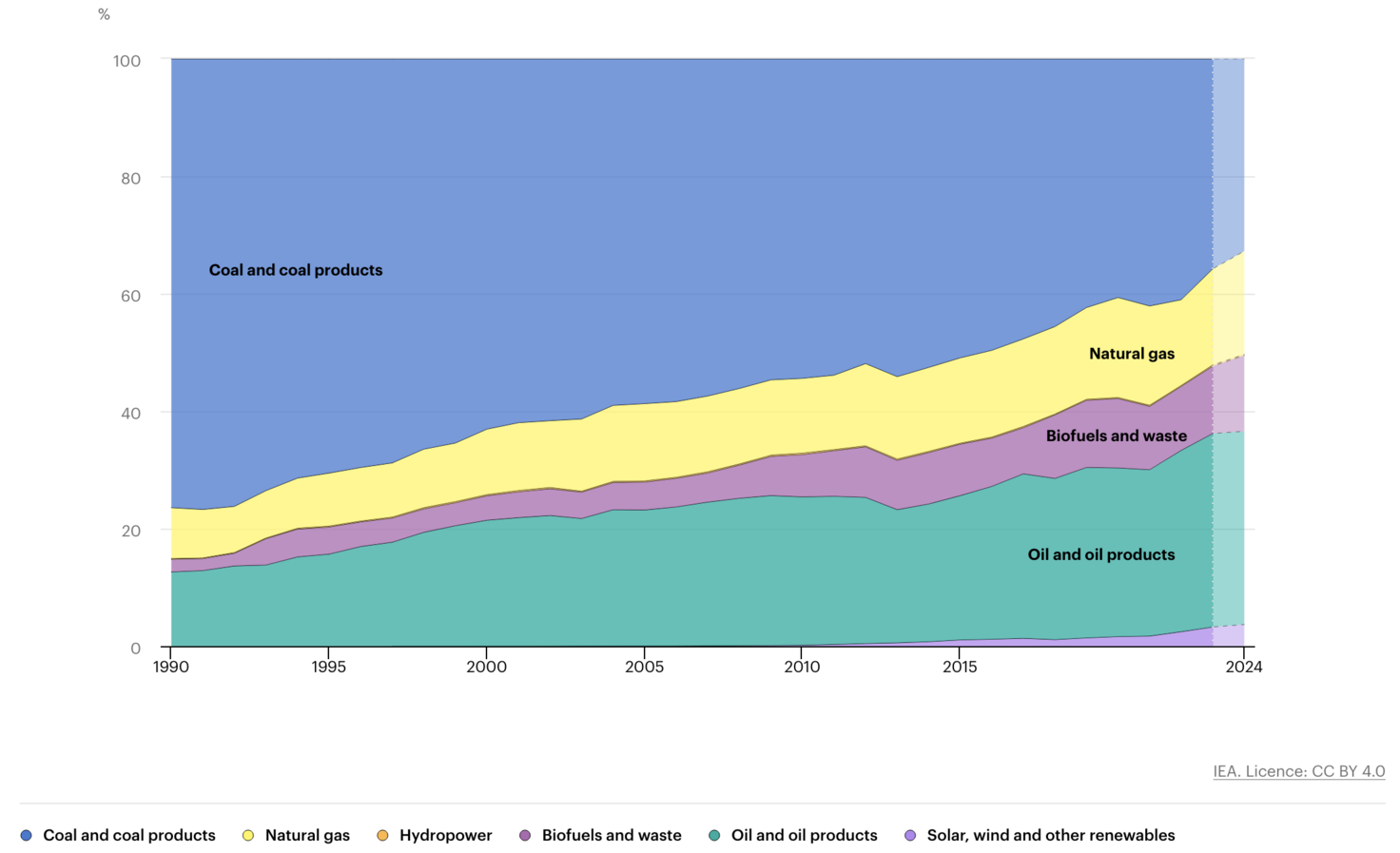
Poland has historically met its energy needs primarily through fossil fuels, particularly a high proportion of coal (coal and coal products in the diagram below). In 2023, fossil fuels represent 85% of Poland’s primary energy consumption, and renewable energies 15% (source: iea ).
Energy Supply Sources in Poland from 1990 to 2023 (in %)
💡 Good to Know What do primary energy and final energy mean?
- Primary energy is the set of unprocessed energy products, directly exploited or imported. These are mainly crude oil, oil shales, natural gas, solid mineral fuels, biomass, solar radiation, hydropower, wind energy, geothermal energy, and energy derived from uranium fission.
- Final energy or available energy is the energy delivered to the consumer for final consumption (gasoline at the pump, electricity at home, etc.).
The report Transformacja energetyczna Polski 2025 shows that Poland remains one of the world’s most greenhouse gas-emitting economies , both per unit of GDP and per energy consumption.
Electricity production in Poland represents 15% of the final energy consumed (source: iea ).
In 2024, Polish electricity still relied mainly on coal (Source: Techniques de l’ingénieur - January 9, 2024 ) and lignite with approximately 57% (35% and 22%) of electricity produced from these sources, 12% by gas-fired power plants. Renewable energy sources account for 25% of the national electricity mix : 15% from wind, 9% from photovoltaic, and 1.3% from hydropower.
Electricity Production in Poland in 2024
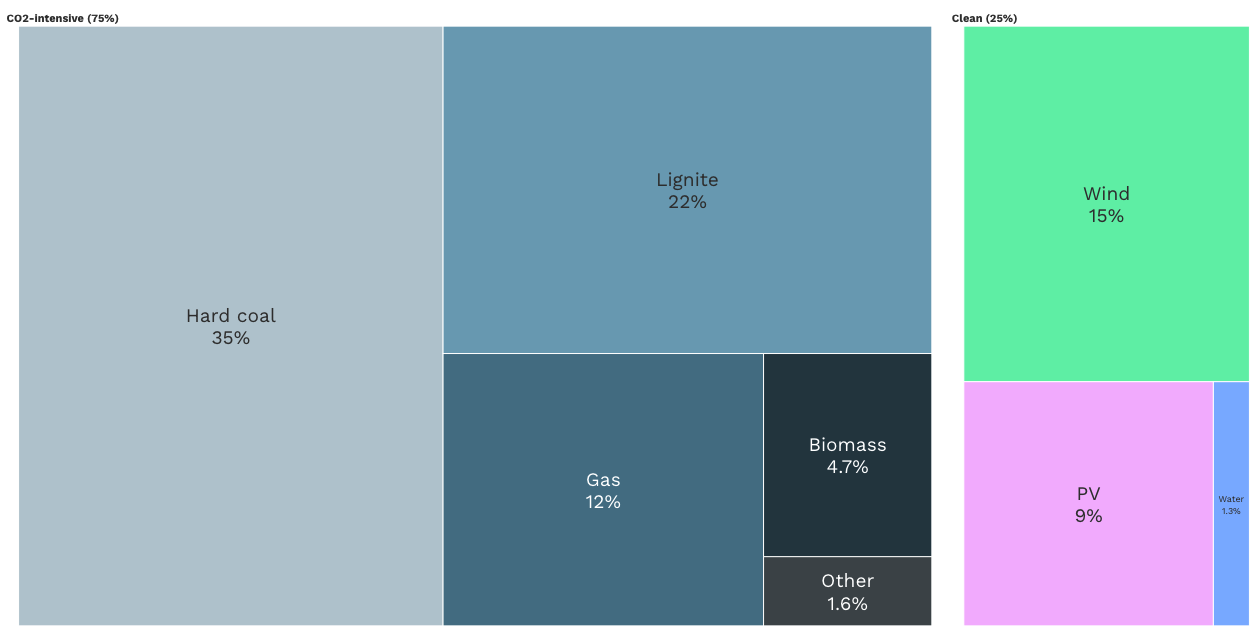
Source: Agencja Rynku Energii for Ministry of Climate and Environment, Energy Regulatory Office
Ambitions for the Future Energy Mix
Poland’s energy mix is characterized by a strong dependence on fossil fuels , the main sources of greenhouse gases , and by dependence on producing countries , particularly Russia for gas and OPEC members for oil.
Faced with these challenges, Poland has set three major objectives:
- Free itself from its dependence on gas, particularly from Russia,
- Abandon historical coal and lignite, which are very high CO₂ emitters,
- Develop its energy independence.
To achieve this, the country is betting on the electrification of uses , the decarbonization of its electricity production through the massive deployment of renewable energies , as well as the construction of its first nuclear power plant.
(Source: Euronews - July 4, 2025 )
Incentive Policy
PEP2040 , Poland’s Energy Policy (PEP) until 2040 (Source: Greensolver - August 12, 2021 ), is a response to the key challenges facing the Polish energy sector and defines its strategic orientations. (Sources: Le Monde - August 18, 2025 & Energynews - September 6, 2024 ) The main points in this Policy are:
- Rapid diversification and growth in energy production from low-carbon sources, which will result in a reduction of more than 50% in CO₂ emissions in the electricity sector by 2040 .
- Reducing the share of coal in electricity production to below 56% by 2030 .
- Increasing the share of renewable energies in gross final energy consumption to at least 23% .
- Increasing the share of renewable energies to 32% in electricity production by 2030, and by 2040 to 40% .
- The construction of the first nuclear power plant, scheduled for 2033 with a capacity of 1-1.6 GW. 6 nuclear units must be built by 2043 with a total capacity of approximately 6-9 GW.
Installed Capacity by Technology from 2014 to 2025 (in GW then %)
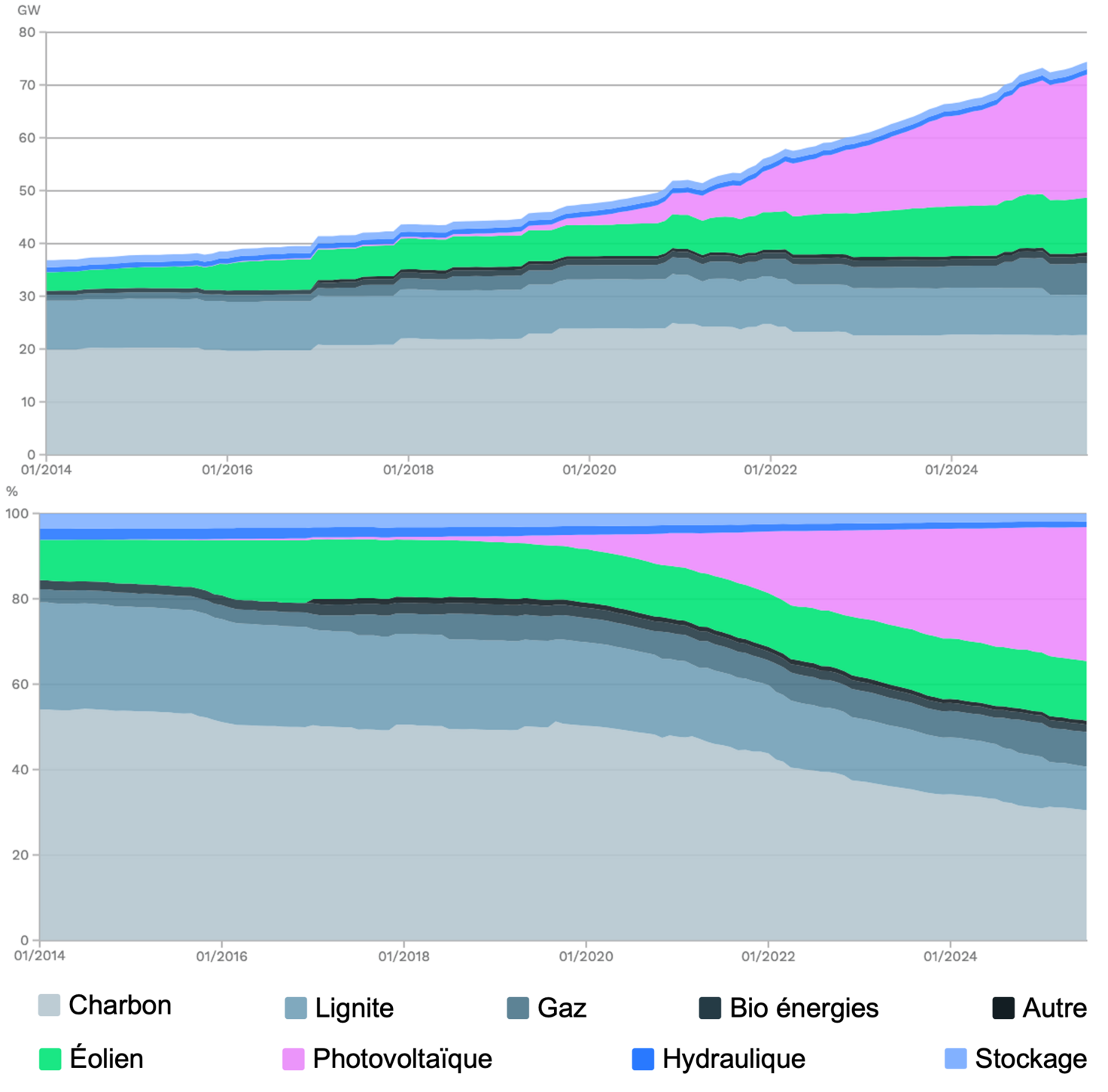
Source: Energy Instrat PL
Interested in this project?
Sign up now to invest responsibly
Impact
Project owners
Windlight Finance is a joint venture owned by Optima Wind and Eiffel Transition Infrastructure, with respective stakes of 55% and 45%.
Optima Wind
Optima Wind is a company specializing in the development, construction, and operation of wind and solar farms, primarily in Poland. Optima Wind has over 15 years of experience in the renewable energy sector. To date, the company has 14 employees, has developed and constructed 150 MW, manages 52 MW, and has a pipeline of 2.8 GW of projects under development (2.1 GW of photovoltaic, 272 MW of wind, and 422 MW of battery storage projects).
Optima Wind is a subsidiary of the Optima group.
Optima will soon begin construction of a photovoltaic project of over 700 MW, one of the largest in Europe.

Jean Claude Moustacakis, CEO
Eiffel Investment Group
Eiffel Investment Group is a major, independent player in asset management in France and Europe, specializing in responsible investment and the ecological and energy transition. The company is part of the Impala group.
The firm manages approximately 8 billion euros in assets under management (as of 30/09/25, including uncalled commitments), with a diversified client base primarily composed of institutional investors (insurance companies, pension funds, banks, etc.) and individuals through distribution networks. Its goal is to invest for a sustainable world, combining financial performance with a positive impact on society and the environment.
Eiffel Investment Group’s investment in the deployment of renewable energies represents 13 GW of capacity distributed across 89 wind farms and 3,585 photovoltaic plants.
Eiffel Transition Infrastructure is an infrastructure fund dedicated to financing greenfield renewable energy projects, primarily in photovoltaic solar and wind. It is through this fund that Eiffel Investment Group participates in the joint venture Windlight Finance.
Eiffel Transition Infrastructure is a fund managed by Eiffel Investment Group strictly reserved for professional investors.
Our analysis
Risk overview
Counterparty risk
Risk of counterparty payment default that would jeopardize the project's cash inflows
Mitigation methods
The joint venture is backed by two major players in the Polish and European energy transition. The funds already committed to these projects demonstrate significant financial strength and the sponsors' ability to provide additional funds if necessary to finalise the development of these projects. In addition, deposits made with the network operator are refundable in the event of project development failure, which will allow the funds committed to be recovered if necessary.
Country risk
Risk of devaluation of local currency, which could impact revenues and compromise ability to service debt.
Mitigation methods
The PLN/EUR exchange rate has remained relatively stable over the years. Furthermore, the total value of the project portfolio could absorb a significant depreciation of the Polish currency, and the borrower would still be able to repay Total Energies Invest's loan (according to the various RtB market prices and the probability of exit from the projects used in the model, which may vary). What is more, Poland's macroeconomic indicators point to strong economic momentum that will support the PLN/EUR exchange rate in the short and medium term.
Development risk
Risk relating to authorizations issued to the company and land, and third-party appeals against authorizations issued.
Mitigation methods
The portfolio comprises 21 solar and wind projects, offering diversification. Windlight has experience and a track record in developing solar and wind projects, with more than 17 years of experience. In addition, the presence of ETI (Eiffel) as a shareholder guarantees a strict framework and schedule. The estimated value of the projects at the RtB stage is significantly higher than the loan amount, which would allow the financing to be repaid with the sale of part of the portfolio, if necessary.
Regulatory risks
Risk of changes in regulations applicable to the sector, involving reductions in subsidies or new taxes with a significant impact on project revenues.
Mitigation methods
Risk is also mitigated by the fact that grid deposit advances are refundable under Polish law in specific circumstances. Local legal counsel confirms investor protections. Diversification across multiple projects further reduces exposure.
Investing in this participatory financing project involves risks, including the risk of total or partial loss of the capital invested. Your investment is not covered by the deposit guarantee schemes established in accordance with directive 2014/49/EU of the European Parliament and of the Council . Your investment is also not covered by the investor compensation schemes established in accordance with Directive 97/9/EC of the European Parliament and of the Council . Return on investment is not guaranteed. This is not a savings product, and we recommend that you not to invest more than 10% of your net assets in participatory finance projects. You may not be able to sell the investment instruments when you wish. If you are able to sell them, however, you may incur losses.