



Finance the construction of a hydroelectric power plant in Indre
The Moulin de Bénavent project, developed by Hydro Energie Pouligny-Saint-Pierre , involves the installation of a hydroelectric turbine and two fish passes at the site of a 14th-century former flour mill in the commune of Pouligny-Saint-Pierre, Indre . Benefiting from a 20-year electricity sales tariff, this installation directly contributes to the creation of renewable and local electricity production with a capacity of 400 kW.
Hydro Energie Pouligny-Saint-Pierre (HEPSP), a company established in 2022 at the initiative of the Pouligny-Saint-Pierre Town Hall to build and operate the hydroelectric plant, is seeking to raise €2,250,000 in two tranches. For this first tranche, the company aims to collect €1,500,000 through simple bonds with an 8.5% interest rate over 3 years.
Construction is expected to begin this summer, with commissioning planned for 2028. The funds raised will cover 80% of the estimated €2.8 million required to complete all works (turbine installation and ecological continuity).
The offer
Contribute to the construction of a hydroelectric power plant in Pouligny-Saint-Pierre
The Pouligny-Saint-Pierre Town Hall, together with the French renewable energy developer SEIDER , wishes to proceed with the installation of a turbine and restoration of fish continuity at the Bénavent mill through its company Hydro Energie Pouligny-Saint-Pierre (HEPSP). It is offering an investment opportunity to install a 400 kW hydroelectric production facility in the municipality.
OBJECTIVE
The crowdfunding operation by Hydro Energie Pouligny-Saint-Pierre aims to raise up to €2,250,000 in senior debt, with an 8.5% interest rate over 3 years .
USE OF FUNDS
These funds will be used by the project leader to finance the construction of a VLH-type hydroelectric turbine and the creation of two fish passes .
REPAYMENT
The repayment strategy will depend on the outcome of a legal appeal related to the project, detailed in the “The Project” section of this page. This judgment is expected in early 2028.
- If the appeal is rejected, bank financing will refinance the €2,250,000 raised.
- If the appeal is upheld, repayment will be made through the activation of SEIDER’s GAPD.
SECURITY
The securities obtained for this financing are:
- A SEIDER GAPD until a final decision is reached on the legal appeal related to the project.
- A first-ranking pledge of 100% of HEPSP issuer shares.
- A pledge without dispossession of the turbine to be installed.
TAX INCENTIVES / TAXATION
The project is eligible for the PEA PME . For more information, visit our blog article on L’Empreinte and our YouTube video on the subject.
LEGAL STRUCTURE & TOTAL ENERGIES INVEST’S ROLE

Specifications
Investment phases
- Investment open to everyone
End of project financing
The closing date for contributions may be extended at the request of the project owner.
The return on your investment will be calculated from the date the subscription certificates are generated, i.e. once all the funds have been received and the legal documentation has been signed by the project owner.
Resources
Simulator
Investment simulation
Moulin de Bénavent -
Obligation
8.5%/year over 3 years
- PEA-PME
Simulation - Rate : 8.5% / year on 3 ans
Initial investment:
€5,000
Repayments and interest:
€6,275
In 3 transfers
| Date | Interest* | Capital | Amount |
| 22/07/2027 | €425 | €0 | €425 |
| 22/07/2028 | €425 | €0 | €425 |
| 22/07/2029 | €425 | €5,000 | €5,425 |
| Total | €1,275 | €5,000 | €6,275 |
|
*Gross interest before tax, including all fees ( view taxation ) The result presented is not a forecast of the future performance of your investments. It is only intended to illustrate the mechanics of your investment over the investment period. The evolution of the value of your investment may vary from what is shown, either increasing or decreasing. |
|||
Interested in this project?
Sign up now to invest responsibly
The project
A historic mill soon to be transformed into a hydroelectric power plant
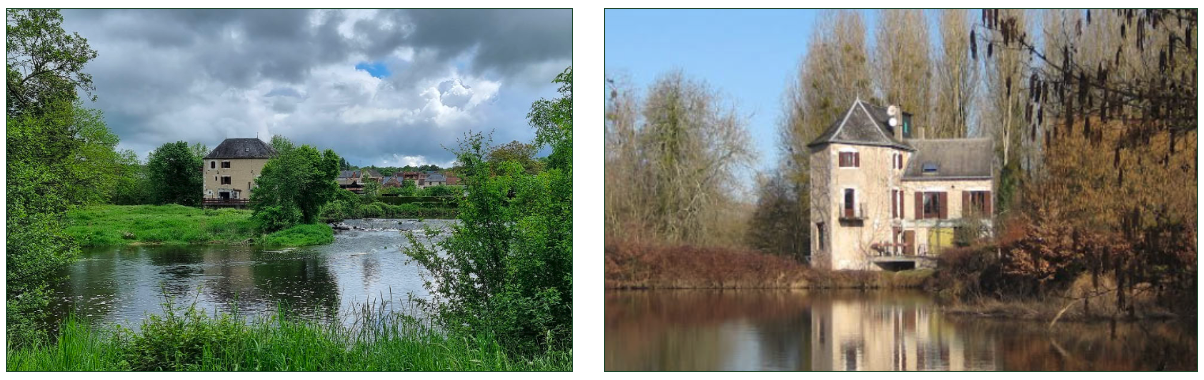
Located on the La Creuse River, which flows through the departments of Creuse, Indre, Indre-et-Loire, and Vienne, the Bénavent weir has a unique history, with the first traces dating back to the 14th century , when a first wheat mill was built and linked to the Méobecq abbey.
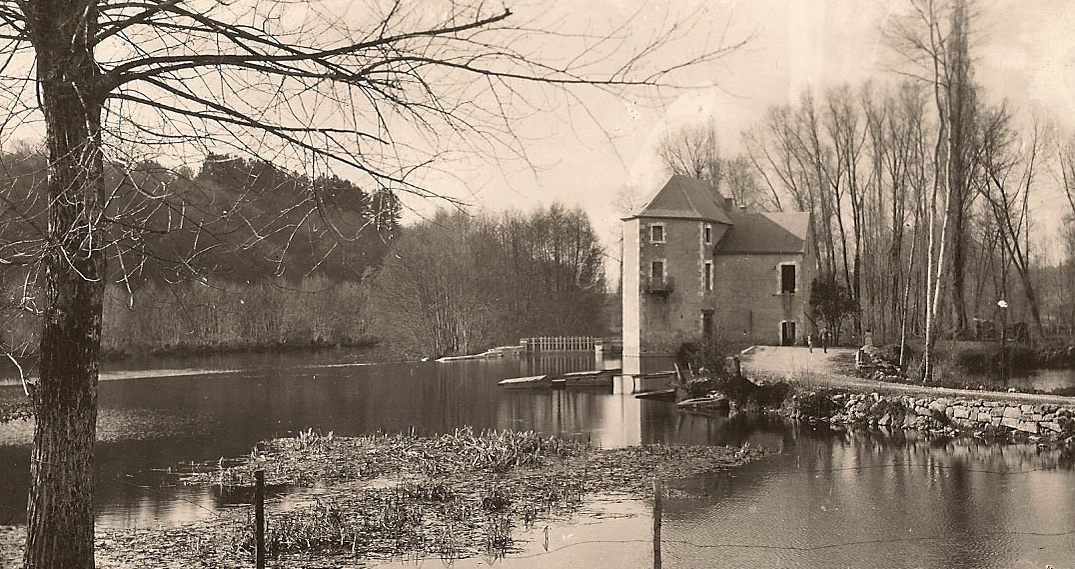
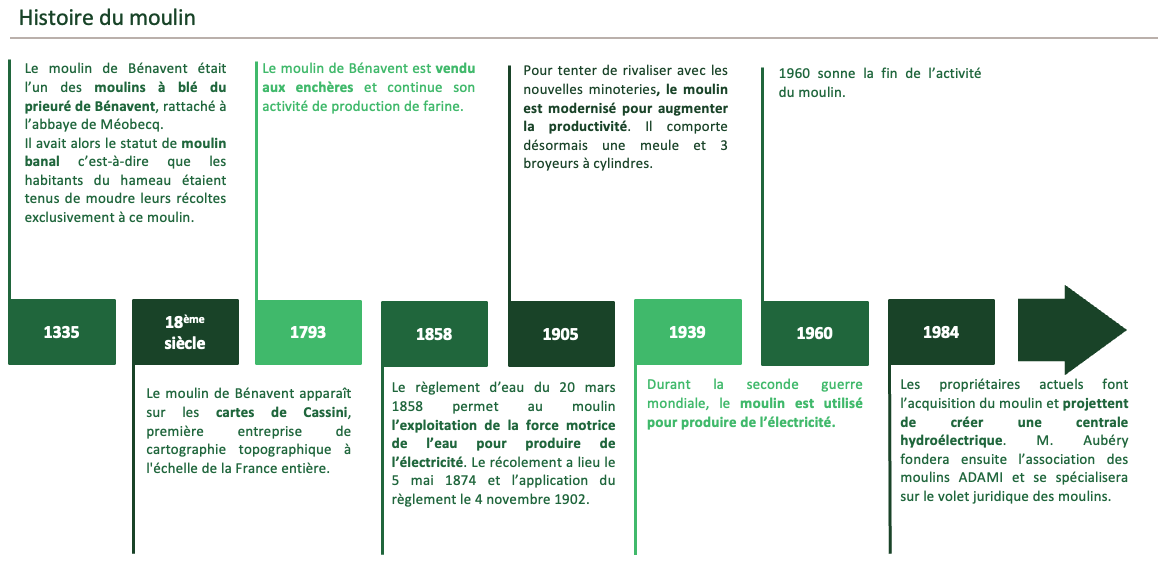
It was in 1984 that the current owners acquired the mill and quickly planned to build a hydroelectric power plant in the commune of Pouligny-Saint-Pierre. Thanks to the impetus from the local council and the support of local stakeholders, including the SEIDER group, the company Hydro Energie Pouligny-Saint-Pierre (HEPSP) was established in 2022 to build and operate the hydroelectric power plant at the Bénavent mill .
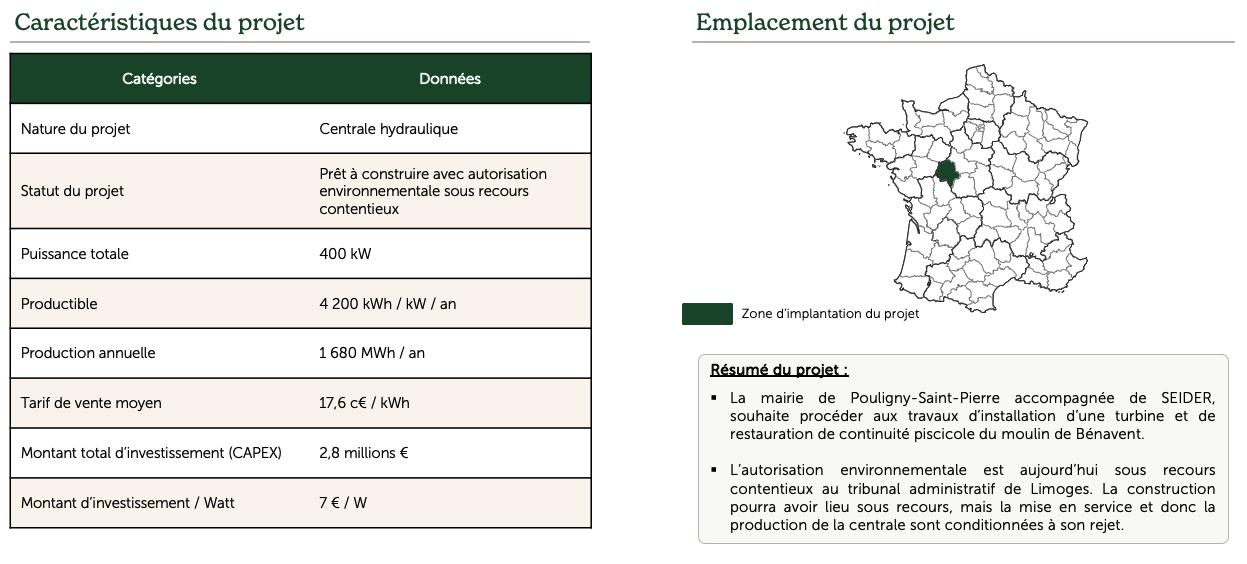
The project plans to install a VLH (Very Low Head) fish-friendly turbine as early as summer 2026 , along with the creation of a fish pass. In summer 2027, a second crossing system will be implemented with the creation of a fish ramp featuring macroroughness to facilitate the passage of aquatic species. With these installations, the power plant will have an installed capacity of 400 kW, producing 1,680 MWh of renewable energy annually , enough to power more than 700 people.
💡 Did you know?
The name VLH turbine actually comes from the specific operation of this type of turbine, whose original patent was filed in 2004: VLH stands for “Very Low Head,” meaning “Very Low Head” in English.
Indeed, the VLH turbine is a technology designed for low-head waterfalls, i.e., less than 4 meters, making it suitable for equipping existing and often old weirs to develop renewable energy.
As a result, the VLH is a turbine that optimizes the overall cost of the installation and its impact on existing structures: reusing an existing low head means less power than a completely new installation, but also reduces the scope and cost of the work.
A legal challenge against the Bénavent mill project
During its development phase, the Bénavent mill project received environmental approval in November 2024, validating the plans for installing a new turbine and restoring fish ecological continuity (fish passes) for hydroelectric operation.
Since the publication of this approval, a coalition of environmental associations has expressed its opposition through several objections. The final court ruling on the appeal is expected by the end of 2027 or early 2028 by the Administrative Court of Limoges.
In this context, work on the Bénavent mill project can begin , but the operation of the power plant and the sale of energy will depend on the court rejecting the appeal.
Having successfully completed all legal steps required for the development of hydroelectric projects , the company is confident about the outcome of this dispute. It has also engaged specialized lawyers to review the arguments raised in the appeal and prepare a response. Here are the conclusions presented in their report:
- The associations lack standing to bring the case, as their area of interest is not mentioned in their statutes.
- The public consultation was fully compliant; the impact study and Natura 2000 impact assessment were complete and sufficient , ensuring that the information provided was neither partial nor misleading.
- The droit fondé en titre (vested right) attached to the structures has not been lost, as the dam is in good condition with no need for full reconstruction; the intake sluice gate remains intact, and the tailrace channel is in perfect condition, with only some siltation noted.
- The project complies with the principle of balanced and sustainable water resource management , as the selected devices meet all requirements set by the Environmental Code.
Work is therefore expected to begin as planned in 2026, with the power plant entering service in early 2028 .
Interested in this project?
Sign up now to invest responsibly
Project owners

 France
In order to successfully carry out the hydroelectric power plant project at the Bénavent mill, the municipality, hydroelectric specialists and local businesses have joined forces.
In 2022, they established a project company in the form of an SAS (Simplified Joint Stock Company) called Hydro Energie Pouligny-St-Pierre , chaired by Roland Caillaud, former mayor of Pouligny-Saint-Pierre, with Christian De Cesare—owner and operator of the Hydroélectrique de la Forge de la Gastevine power plant—heading up technical management, and Didier Boureaud, manager of SEIDER, overseeing administrative and financial management. Currently, the company includes the municipality of Pouligny-Saint-Pierre, companies specializing in hydroelectricity or renewable energies, and individual shareholders.
HEPSP also has Dominique Verron on its board of directors, who contributes his network and expertise in project financing.
SEIDER, a leading partner in renewable energy development
Established in 2007 , SEIDER is a French renewable energy developer based in Normandy and Centre-Val de Loire , historically specializing in wind energy projects and now expanding into solar, storage, and hydrogen projects.
With a focus on local development, SEIDER currently operates 4 regional offices in Caen, Rouen, Tours, and Châteauroux. This ensures close collaboration with all project stakeholders (partner engineering firms, contractors, public representatives, and local residents), optimizing project management and oversight.
This strategy has enabled them to build a portfolio of assets including over 50 MW of approved projects in Seine-Maritime .

Our analysis
Risk overview
Construction risks
Risk of higher construction costs due to rising raw material prices
Mitigation methods
The VLH turbine has already been ordered and manufactured, so its cost is under control. Payment for and delivery of the turbine will be covered by the funds raised during this first installment.
Development risk
Risk relating to authorizations issued to the company and land, and third-party appeals against authorizations issued.
Mitigation methods
The main risk associated with the project is that the administrative appeal regarding the environmental permit could be dismissed. Indeed, the EDF OA H16 bis feed-in tariff is guaranteed for 20 years, and the preliminary technical approval (PTF) for the connection has been received.
Refinancing risk
Credit risk related to the company's ability to refinance and meet its debt obligations.
Mitigation methods
The repayment risk stems from the risk associated with the outcome of the legal challenge to the environmental permit. If the challenge is dismissed, most of the project’s risks would be eliminated. For a hydroelectric power plant with a guaranteed electricity sales rate upon completion of construction or commissioning, the release of the bank guarantee would allow for the full repayment of the Total Energies Invest debt. Otherwise, the bonds would be repaid through the enforcement of collateral (GAPD, pledge, and mortgage).
Investing in this participatory financing project involves risks, including the risk of total or partial loss of the capital invested. Your investment is not covered by the deposit guarantee schemes established in accordance with directive 2014/49/EU of the European Parliament and of the Council . Your investment is also not covered by the investor compensation schemes established in accordance with Directive 97/9/EC of the European Parliament and of the Council . Return on investment is not guaranteed. This is not a savings product, and we recommend that you not to invest more than 10% of your net assets in participatory finance projects. You may not be able to sell the investment instruments when you wish. If you are able to sell them, however, you may incur losses.