





Finance energy renovation and energy efficiency projects with CEE thanks to Loris Enr
LORIS ENR is a French company specializing in financing energy renovation projects through the Energy Savings Certificates (CEE) scheme. It acts as an administrative and financial intermediary between the obligated parties and construction companies carrying out energy efficiency work.
As part of its activities, and with the support of Total Energies Invest, LORIS ENR is launching a short-term bond issue to finance its CEE purchase activity from partner installers. This first bond issue aims to raise 1,000,000 €, with a ceiling of up to 2,500,000 €, over a period of 3 years with a gross interest rate of 9% per year.
This issue will benefit from a trust security arrangement set up to monitor the use of funds, secure claims, and protect investors. In concrete terms, the funds raised will be placed in a dedicated bank account under the control of the trustee and will be disbursed exclusively for the advance payment of work costs to partner installers, subject to the presentation of appropriate supporting documents.
The offer
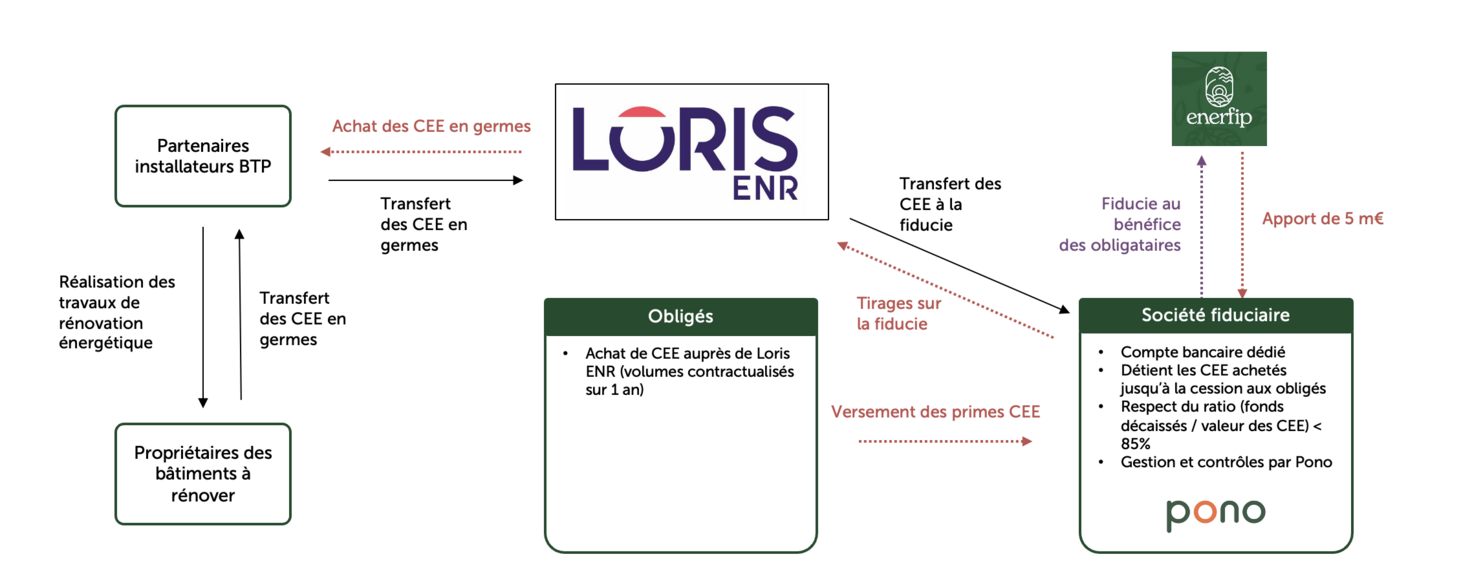
LORIS ENR, a French company, offers an investment opportunity in its CEE (Energy Saving Certificates) valorization activity. Through this activity, LORIS ENR finances construction companies (BTP) carrying out energy renovation work in France. In practice, LORIS ENR buys volumes of CEEs in the process of being constituted from selected partners, after verifying the operations generating the CEEs, and has them validated by the PNCEE (National Pole for Energy Saving Certificates) before selling them to counterparties with obligations to purchase CEEs, known as “Obligés.”
For more information on how LORIS ENR’s activity works, please refer to the “Project” section.
The activity of buying, valorizing, and reselling CEEs generates a natural working capital need for LORIS ENR, which wishes to issue bonds to finance it and accelerate the volumes negotiated in a growing market.
OBJECTIVE
The crowdfunding operation of LORIS ENR aims to raise up to 1,000,000 € in the form of senior debt, with a potential increase up to 2,500,000 €.
USE OF FUNDS
The funds will be placed in a fiduciary bank account and will allow the purchase of CEEs from the network of partner installers, which will be placed on the asset side of the Trust. Once the work and associated energy savings are verified and deposited, the corresponding CEE premiums will be paid directly into the fiduciary account.
REPAYMENT
The repayment of the capital and the payment of interest are guaranteed by the sale of CEEs to the obligés, after validation of the work carried out by the partner installers. All financial flows are directed towards a fiduciary security , beneficiary of the CEE claims and the payments from the obligés.
The funds advanced to the installers (participatory loans) are recovered in the trust on average within 3 months, once the premiums are received. A collateralization ratio of ≤ 85% is controlled at each draw, ensuring that the CEEs in the process of being bought by LORIS ENR and placed on the asset side of the trust always cover the remaining outstanding bond amount.
SECURITY
For this operation, the presence of a fiduciary security , benefiting the bond investors, will include:
• On its asset side, the CEE claims constituted by LORIS ENR, CEE claims in the process of being bought by LORIS ENR from partner installers, and the receipts upon payment of CEEs by the obligés
• On its liability side, the funds lent by the bond investors until
full use of said funds.
LORIS ENR will not be able to make a draw request during the 6 months preceding the maturity date of the bond issue to ensure recharging of the trust via the receipts of CEE payments and allow organic repayment.
TAX BENEFITS
The LORIS ENR CEE project is eligible for the PEA PME. If you wish to know more, we invite you to read our blog article on L’Empreinte , watch our video on YouTube , or browse our on the subject.
LEGAL STRUCTURE AND TOTAL ENERGIES INVEST’S INVOLVEMENT
Specifications
Investment phases
- Investment open to everyone
End of project financing
Resources
Simulator
Investment simulation
LORIS ENR CEE -
Obligation
9%/year over 3 years
- PEA-PME
Simulation - Rate : 9% / year on 3 ans
Initial investment:
€5,000
Repayments and interest:
€6,350
In 12 transfers
| Date | Interest* | Capital | Amount |
| 19/04/2026 | €112.5 | €0 | €112.5 |
| 19/07/2026 | €112.5 | €0 | €112.5 |
| 19/10/2026 | €112.5 | €0 | €112.5 |
| 19/01/2027 | €112.5 | €0 | €112.5 |
| 19/04/2027 | €112.5 | €0 | €112.5 |
| 19/07/2027 | €112.5 | €0 | €112.5 |
| 19/10/2027 | €112.5 | €0 | €112.5 |
| 19/01/2028 | €112.5 | €0 | €112.5 |
| 19/04/2028 | €112.5 | €0 | €112.5 |
| 19/07/2028 | €112.5 | €0 | €112.5 |
| 19/10/2028 | €112.5 | €0 | €112.5 |
| 19/01/2029 | €112.5 | €5,000 | €5,112.5 |
| Total | €1,350 | €5,000 | €6,350 |
|
*Gross interest before tax, including all fees ( view taxation ) The result presented is not a forecast of the future performance of your investments. It is only intended to illustrate the mechanics of your investment over the investment period. The evolution of the value of your investment may vary from what is shown, either increasing or decreasing. |
|||
Interested in this project?
Sign up now to invest responsibly
The project
What is the CEE Scheme?
The Energy Savings Certificates (CEE) scheme was created in 2005 by the POPE Act, which sets out the guidelines for energy policy. It is based on a triennial obligation to achieve energy savings in CEE (1 CEE = 1 kWh cumac of final energy) imposed by the public authorities on energy suppliers known as the obligated parties. These obligated parties are encouraged to actively promote energy efficiency among energy consumers: from households to local authorities, including industrial and commercial enterprises.
The scheme works as follows:
- The state requires large energy suppliers (the “obligated parties”) to help energy consumers save energy.
- After helping consumers reduce their energy consumption, energy suppliers obtain CEEs, which account for the amount of energy that will be saved in the future thanks to the work carried out (measured in kWh “cumac” for Cumulative and Actualized).
- Suppliers have a volume of CEEs to obtain during each period. If the target is not met, the supplier must pay a high penalty.
- The obligated parties can also delegate each of their obligations to a third party, known as a delegate (periodically approved by the PNCEE), either totally or partially to a minimum of 1 TWhc.
The certificates issued are recorded in the national register of energy savings certificates, which also records all transactions (sales and purchases) of certificates and provides regular public information on the average exchange price of the latter. This register is accessible on the website www.emmy.fr .
In addition, checks are carried out by the National Energy Savings Certificates Office (PNCEE) to verify the eligibility of operations leading to the issuance of CEEs. In case of non-compliance, sanctions can be imposed.
💡 kWh cumac? The term “cumac” is a contraction of “cumulative” and “actualized.”
For example, the amount of kWh cumac saved following the installation of an energy-efficient device corresponds to the sum of the annual energy savings made during the product’s lifetime. The energy savings made in each year following the first are actualized by dividing the savings of the previous year by 1.04 (actualization rate of 4 %).
How Loris ENR Works
In the CEE scheme, LORIS ENR acts as a CEE delegate . The company supports businesses carrying out energy renovation work, mainly in the tertiary sector. After a rigorous selection of these partners, and after the work has been carried out, LORIS ENR mandates a check before buying the rights on the CEEs being constituted (“the CEEs in the bud”). After this purchase, LORIS ENR submits them to the PNCEE for control and validation. After this step, they can then be sold by LORIS ENR to the Obligated Parties.
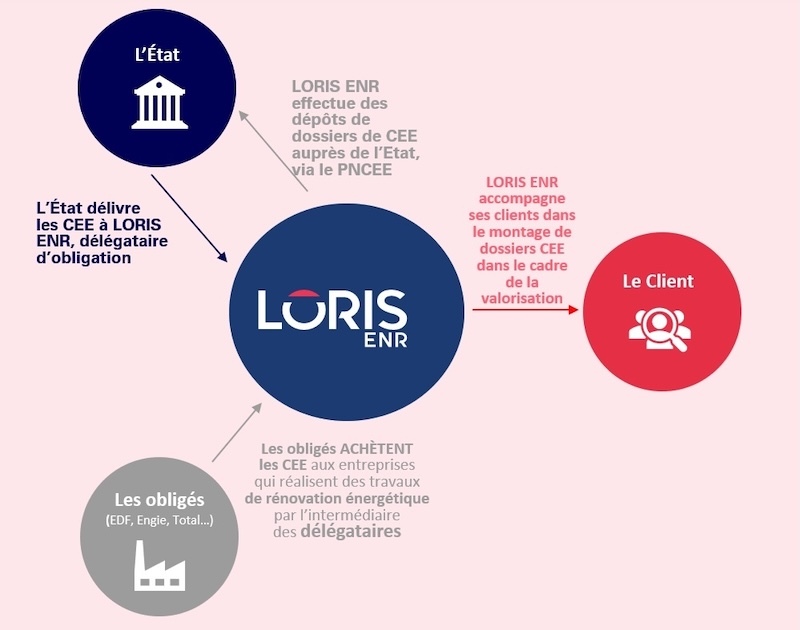
LORIS ENR’s internal activity is mainly focused on companies wishing to carry out energy-saving work. The process is sequential, from the signing of the agreement, through the validation of the file with the PNCEE, to the return of the CEE premiums to the clients.

Control Methods
Once the operations have been administratively validated, they are grouped into thematic batches, depending on the type of form, the date of commitment of the operations and any alerts identified. This organization makes it possible to target actors or types of operations potentially at risk, while ensuring that sensitive cases are systematically included in the batches controlled. On-site checks are carried out at a minimum at the required regulatory rate, but can be reinforced beyond this — some operations even being subject to a 100% check, depending on the risk analysis of LORIS ENR.
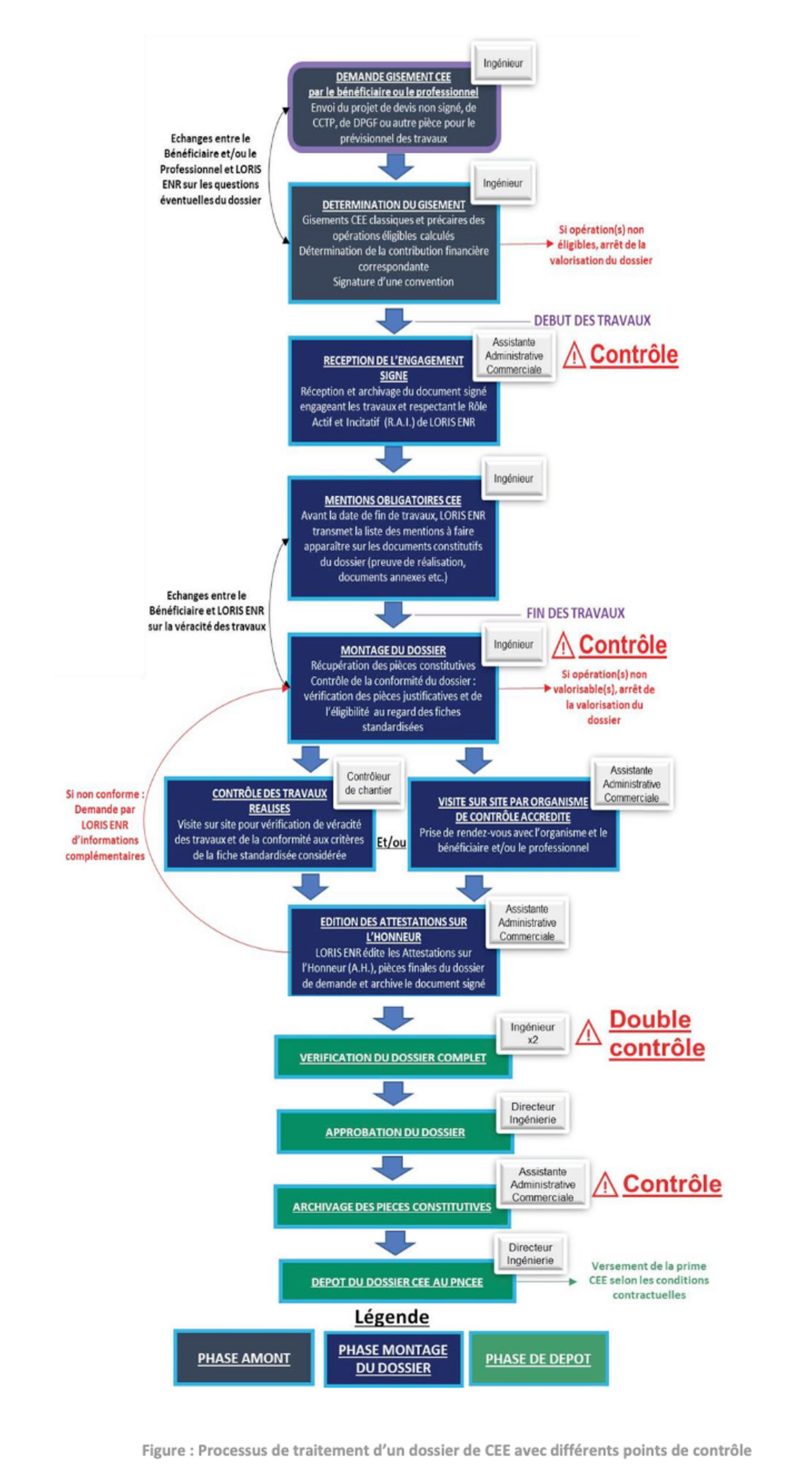
The Operation
As part of its activities, LORIS ENR is seeking to issue a bond to finance its working capital needs dedicated to the purchase of CEEs from partner installers. This bond issue will be carried out through a dedicated trust, which will allow the payment of CEEs after checking their validity, in order to resell them to the obligated parties.
To Find Out More
If you would like to learn more about the CEE mechanism, do not hesitate to consult the following links:
Interested in this project?
Sign up now to invest responsibly
Project owners
LORIS ENR was founded in 2015 by its two founders, Aurélie Gaudillère and Thierry Martin, to enhance the value of Energy Savings Certificates (CEE). LORIS ENR is one of the CEE delegates accredited by the Ministry of Ecological Transition. As a delegate, LORIS ENR assists its clients in optimizing and financing energy renovation projects, thanks to the Energy Savings Certificates (CEE) scheme.
Led by Paul Petit, LORIS ENR employs 40 people. Its 2024 turnover amounts to 200 million euros. Since its creation, the company has developed solely with its own funds, without resorting to third-party capital.
🤝 Synergy of the Davail Group
Loris is part of the Davail Investment group, which has several subsidiaries specializing in energy transition:
- Enerlis : A global player in decarbonization since 2013, serving real estate companies, large groups, and territories. It employs 100 people across 10 agencies and achieves a turnover of 40 million euros.
- Girasole Energies : A photovoltaic energy producer employing 100 people. Girasole has already completed over 500 photovoltaic power plants.
- Régie Solaire : An installer of solar power plants and storage systems employing 30 people, with a turnover of 10 million euros.
🔋 Resources and Exploitation Means
LORIS has developed an internal platform that gives it control over its activity. It allows for close monitoring of regulatory developments and market requirements. This central platform tracks all activities, particularly the CEE chain from quoting for a supplier to selling to an obligated party. The platform offers complete traceability of CEEs.
Each file is reviewed and validated by an engineer under the responsibility of a project manager. Engineers thus make up the majority of LORIS's human resources.
✅ ISO 9001 Certified
Certification renewed in 2021, a true mark of confidence for its clients, guaranteeing reliability and service quality.
1️⃣ First Program Funded by LORIS ENR
The first program funded by LORIS ENR, the ECCO DOM program, focuses on implementing actions for energy renovation in social housing and training for tourism actors in the Overseas Territories.
👍 99.5% of CEE Applications Validated
Rigor and expertise have enabled LORIS ENR to have 99.5% of their CEE applications validated by the PNCEE.
💹 Financial Situation
The 2024 turnover shows strong growth over the 2023 exercise. It reaches a record of 201 million euros against 78 (+120%). This increase results from the rise in the number of CEEs collected and their value (+11%).
| Year | 2022 | 2023 | 2024 |
| Turnover (k€) | 53,642 | 77,525 | 201,317 |
| Total TWhc | 14.28 | 10.53 | 22.96 |
| # Obligated | 12 | 14 | 15 |
| Average Price (€/MWhc) | 6.43 | 7.17 | 8.15 |
Our analysis
Risk overview
Refinancing risk
Credit risk related to the company's ability to refinance and meet its debt obligations.
Mitigation methods
La mise en place d’une fiducie-sûreté au bénéfice des obligataires permet de limiter leur exposition de deux façons : Utilisation des fonds conditionnée à la réalisation effective des travaux ; Cession des créances de prêt participatif + délégation des flux EDF directement dans la fiducie ; Contrôle des tirages avec vérification du respect du ratio de collatéralisation à chaque étape. La documentation prévoit également le respect du ratio de collatéralisation suivant : (Montant du nominal restant à rembourser – liquidités disponible sur le compte de la Fiducie-Sureté ) / (Somme des CEE cédés à l'actif de la fiducie) inférieur ou égal à 85 %. Ces deux éléments doivent permettre de maintenir à tout moment un collatéral supérieur au montant restant dû au titre des obligations tout en le protégeant en cas de procédure collective.
Regulatory risks
Risk of changes in regulations applicable to the sector, involving reductions in subsidies or new taxes with a significant impact on project revenues.
Mitigation methods
La sixième période su dispositif des CEE (2026-2030) a été confirmée par le gouvernement et sera bien mis en place. Actuellement, deux éléments sont encore en attente avant la publication officielle: i) validation par le Conseil d’État des dispositions relatives aux combustibles liquides et ii) la stabilisation du gouvernement, condition nécessaire à la signature du décret. Le décret en Conseil d’État officialisant la période P6 est prévu pour publication à l’automne 2025. En attendant cette publication, une prolongation de la P5 est envisagée afin d’assurer la continuité du dispositif. Il n’existe à ce jour pas risque majeur sur la pérennité du dispositif.
Market risk
Risk related to being in a competitive market where new players enter the competition each year
Mitigation methods
LORIS ENR est une société historiquement rentable, avec un excellent track-record de dossiers CEE validés auprès de obligés : le taux de succès s’établit à plus de 99.5%. De plus, LORIS ENR évolue dans un secteur très réglementé dans lequel le statut de délégataire est octroyé par le PNCEE pour le Ministère de la transition énergétique. La société possède d’importantes ressources humaines et financières, s’appuyant sur une équipe d’experts et le soutien de Davai Investments, société d’investissement spécialisée dans la transition énergétique et l’efficacité énergétique.
Investing in this participatory financing project involves risks, including the risk of total or partial loss of the capital invested. Your investment is not covered by the deposit guarantee schemes established in accordance with directive 2014/49/EU of the European Parliament and of the Council . Your investment is also not covered by the investor compensation schemes established in accordance with Directive 97/9/EC of the European Parliament and of the Council . Return on investment is not guaranteed. This is not a savings product, and we recommend that you not to invest more than 10% of your net assets in participatory finance projects. You may not be able to sell the investment instruments when you wish. If you are able to sell them, however, you may incur losses.